
IMPACT MEASUREMENT
SUMMARY

1️⃣ ALL ABOUT IMPACT MEASUREMENT
🧪 What is an LCA?
 https://www.fairlymade.com/blog/cest-quoi-une-acv
🇪🇺 Environmental labelling methods: a rapidly evolving subject in Europe and in France
https://www.fairlymade.com/blog/les-methodes-daffichage-environnemental-un-sujet-en-pleine-evolution-en-europe-et-en-france🔖 Environmental labelling, the future of our clothes
https://www.fairlymade.com/blog/les-methodes-daffichage-environnemental-un-sujet-en-pleine-evolution-en-europe-et-en-france
2️⃣ F.A.Q. - IMPACT MEASUREMENT
🌍 Environmental
What database do you use for impact measurement?
Fairly Made® uses several databases to achieve the most accurate results possible.
- The CODDE database (Bureau Veritas database)
- The EF 3.0 and 3.1 database
- The Empreinte database
(future update of the Impact database - Fairly Made® is part of the committee of experts working on its development)
- We also have access to the EcoInvent database, which can be used in specific cases.
How are the distances traveled (KM) calculated?
The number of Km between factories is calculated based on their respective addresses and the transport routes (e.g truck, boat, plane) that suppliers identify.
When we do not have the exact address of the supplier, we use standard data for country distances and use the most common transport route used.
We always calculate the most direct transport route possible without passing through transit warehouses or possible stops to pick-up other loads.
Can the data collected by Fairly Made® be used for Scope 3 of the carbon footprint?
Yes, the carbon footprint of products analyzed by our LCA is great information to contribute to an accurate Scope 3 carbon measurement. We take the CO2 impact per product and times it by the volume.
However, for the sake of coherence, it is important for all product typologies (or even better, all products) to have an LCA in order to have a coherent Scope 3.
Does Fairly Made® take durability into account?
Durability tests are currently not taken into account in the calculations because no coherent methodology has been adopted yet. However, it will be considered in the framework of the European PEF rating.
Are you interested in the topic of durability?
Fairly Made® has among its members a doctor in textile process engineering, whose research focuses on product durability.
Can certain components be excluded from the impact measurement calculation?
Yes. It is possible to exclude certain components from the calculation if the sum of their mass is less than 5% of the total mass of the product.
This is called a cut-off rule.
🤝 Social
How does Fairly Made® calculate the Social score?
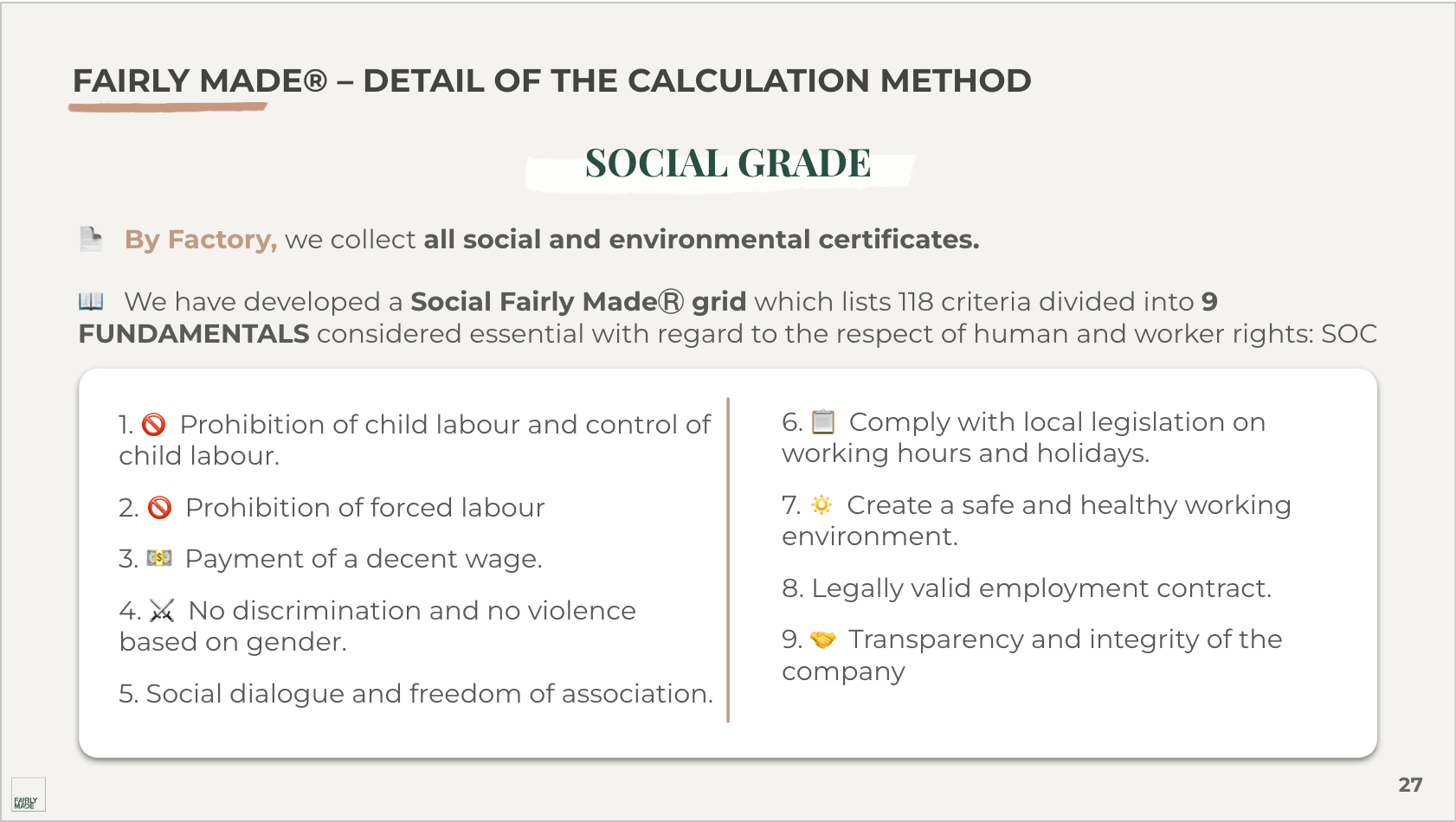
We assign each of our suppliers a "social score" to assess their social compliance. This score based on the following elements:
- The collection and verification of social certifications for each supplier.
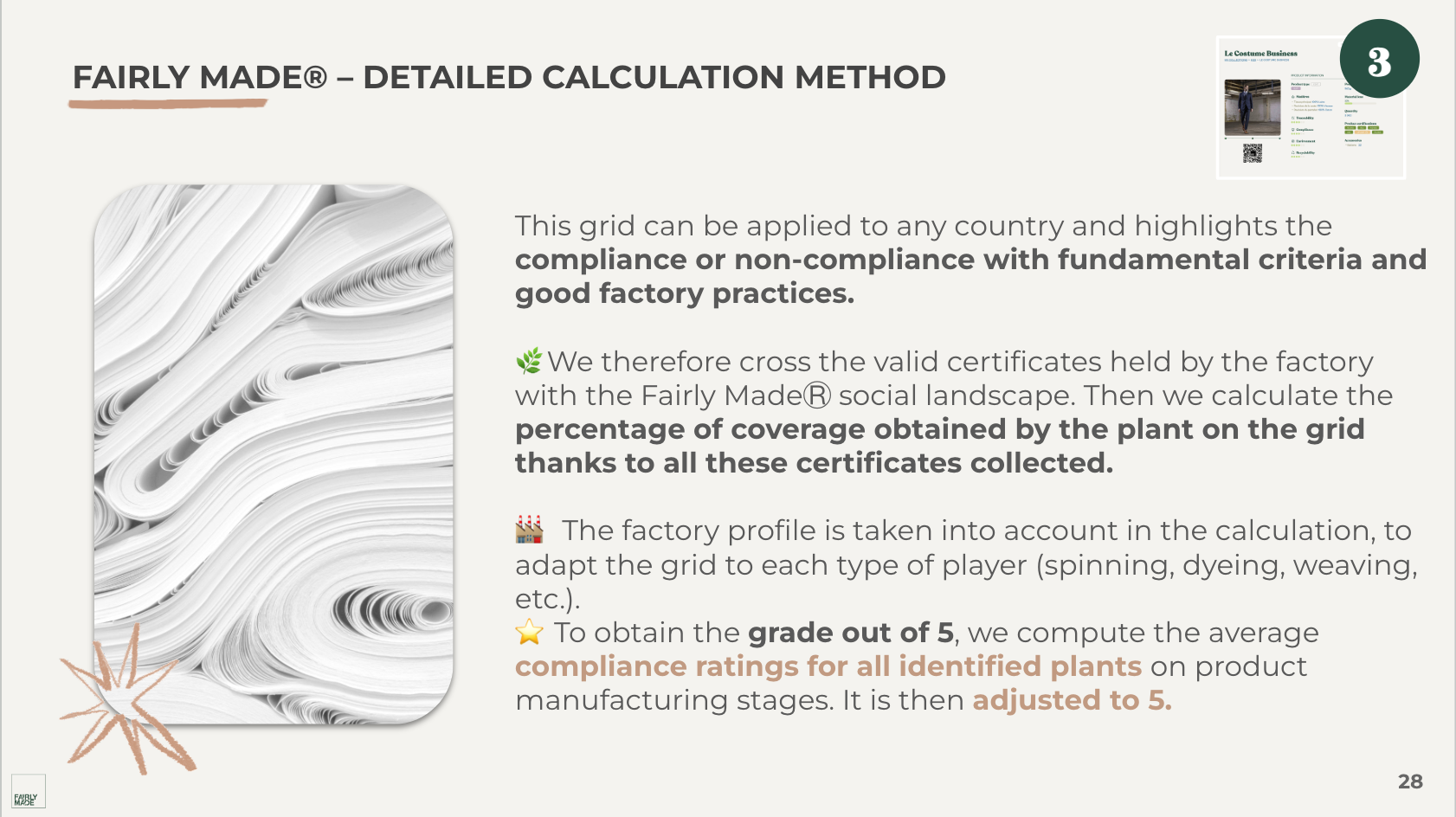
- Once these certifications are collected, their scope is cross-references against a list of 110 social criteria that we have established with the Fair Wear Foundation. The cross-over results in a social score in % for each supplier (this list of criteria can be presented during the call for tenders if necessary).
- At product level, we assign a social compliance score per product. This relates to the average social score of the suppliers in the supply chain for that product, then harmonised to a score of 5.
⚠️ These scores are for internal use only and only provide an initial idea of their social compliance.
Indeed, there is currently no government methodology to measure social impact, which is why this score is not included in Fairly Made® product sheets.
♻️ Recyclability
How does Fairly Made® calculate product recyclability?
We have created our own internal recyclability potential calculator based on a Refashion study, which is modulated based on obstacles to recyclability (e.g a shoe with 10 components will receive a lower score than a 100% cotton t-shirt).
As soon as the Refashion indicator is available, our methodology will be aligned.