
BRAND DATA COLLECTION
SUMMARY

BRAND DATA COLLECTION
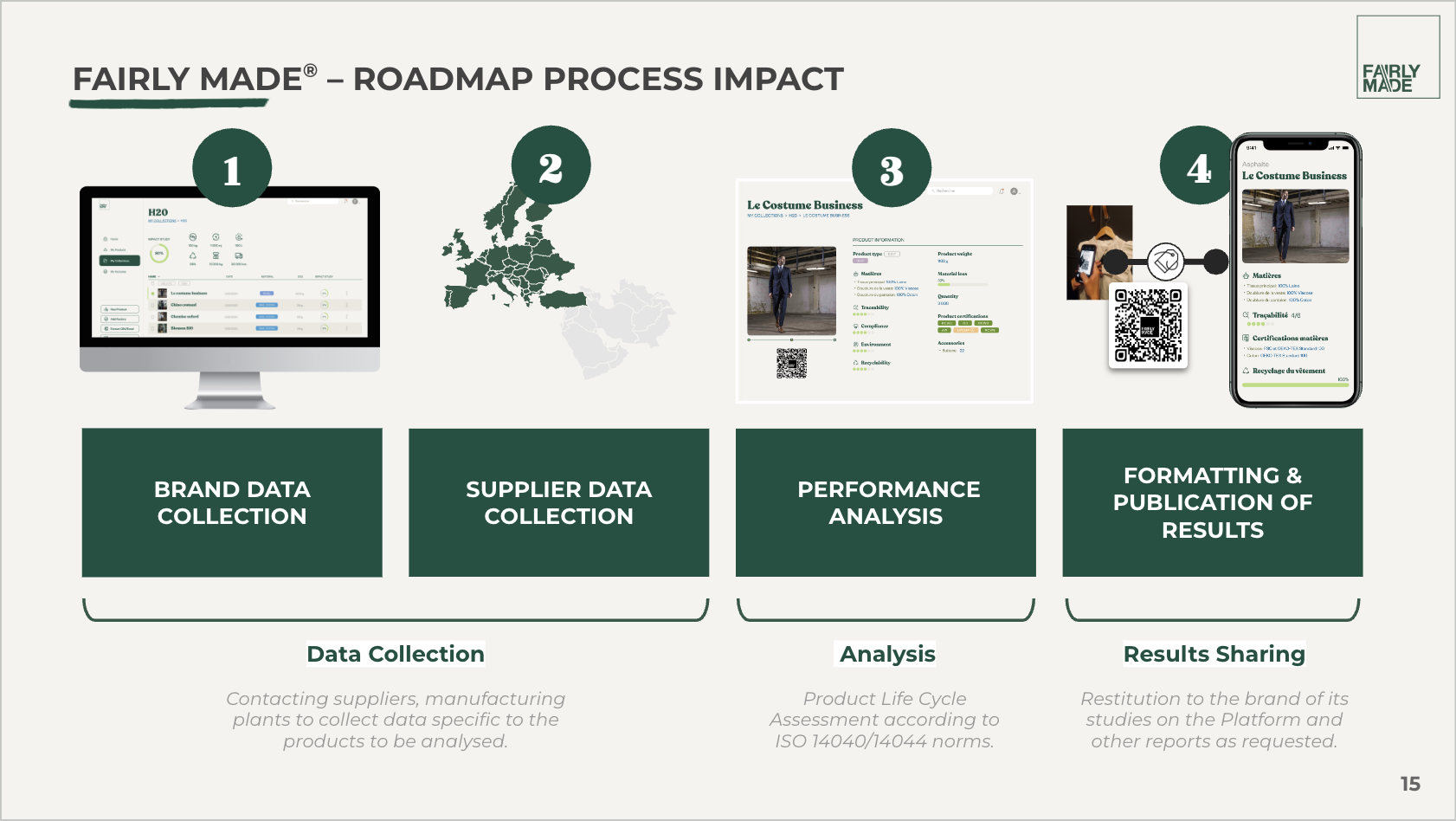
The Process
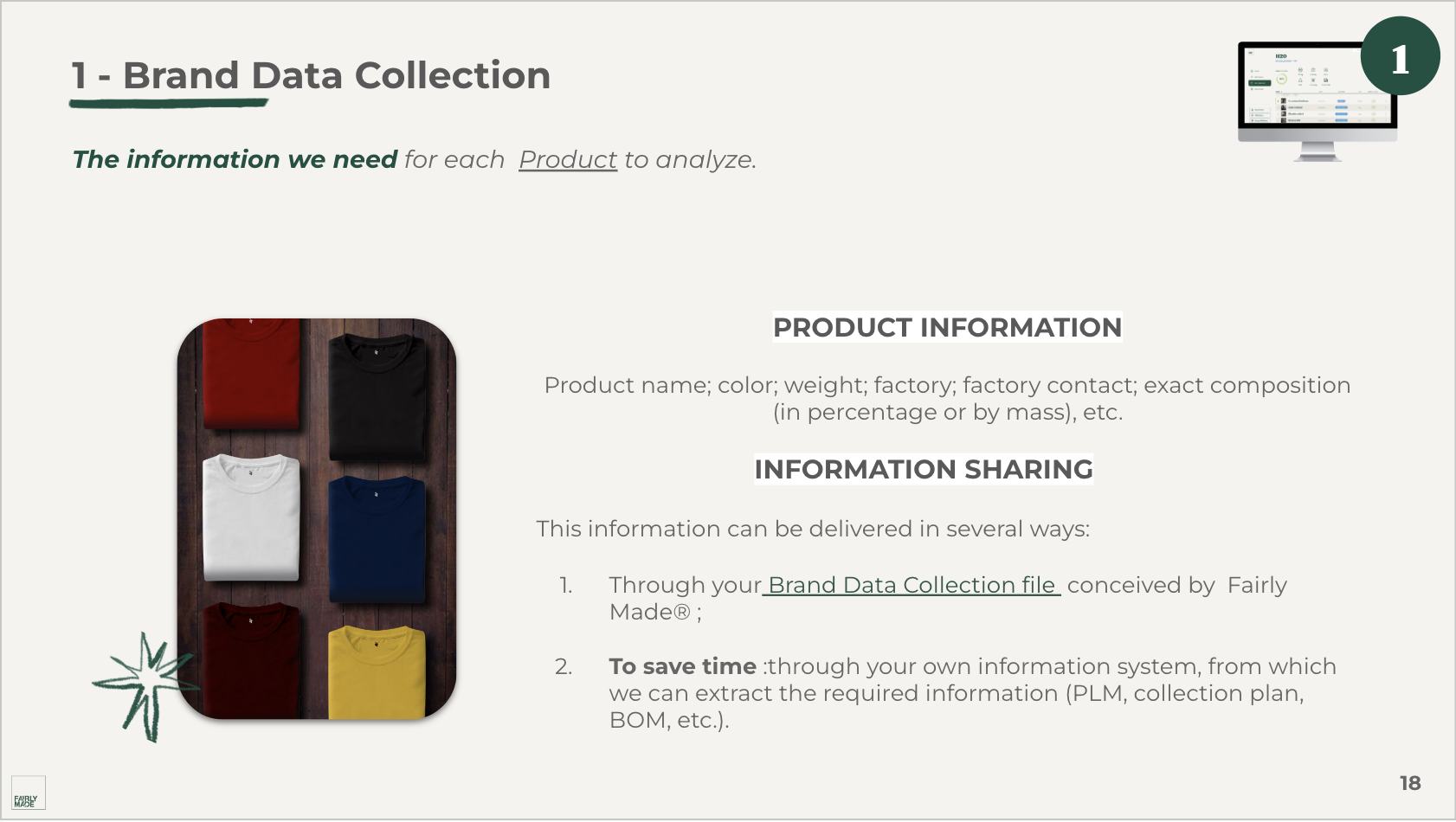
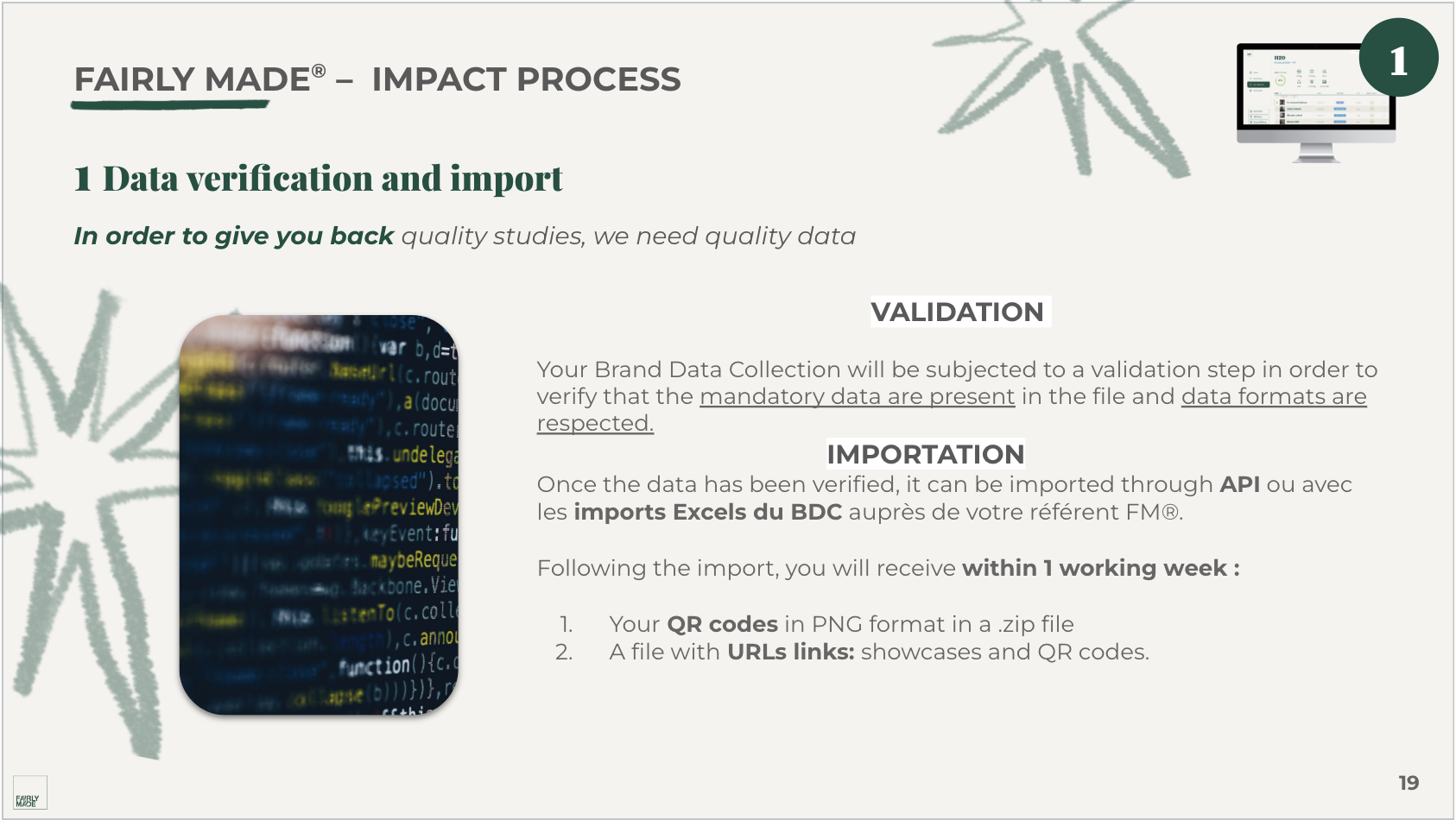
🔑 Golden Rules of Brand Data Collection
- No merging of cells
- No line breaks within a cell
- No changing the order and name of columns
- No adding or deleting columns
- Please follow the required format and taxonomy for the components.
- Ensure that data related to unique supplier, unique component, unique product, and unique packaging are consistent across tabs.
Finally, if you want to send us your supplier database so that we can integrate them, you can do so, but make sure not to modify the unique supplier reference.
❓F.A.Q.
What do I need to do to complete the Brand Data Collection?
At Fairly Made®, we always work in the same way: we need input data from the brand and/or suppliers to feed our calculator, which will provide output data on scores and calculations, for example.
You can retrieve these results in the form of raw data or via our product showcase, directly available on the Fairly Made® platform.
The Brand Data Collection file consists of 7 tabs:
- Home: document usage guide
- Data Model: document dictionary, each field has a definition, an example, and completion option rules (e.g taxonomy or not)
- Suppliers: information related to your suppliers
- Products: information related to the products being analysed
- Components: information related to the components of the products
- Packaging: information related to the packaging of the products
- Taxonomy / Geo Data: standard drop-down lists
4 tabs need to be completed by you: Suppliers, Products, Components, and Packaging.
As you go through these four sections, you will see 2 types of colours:
- The columns in dark green are for mandatory data, the minimum data required for us to conduct the study.
- The columns in light blue are for optional data. This information enables us to further our study but it is not essential.
When you browse and complete this file, you will see a mention that frequently appears, that of "Ref." This mention, preceded by the adjective "Unique," is necessary for each tab and object (Supplier, Products, Components, Packaging) to match the different data together. Repeated data from one tab to another allows us to connect the component to the product to the supplier.
[Instructions]
Tip: You can work step by step, and we recommend following this order: Suppliers - Packaging - Product - Component
CHAP 2 - Data Model
This is the dictionary of the document, each field has a definition, an example, and possibly filling rules.
- In the first column, you will see the data object: Product, Component, Supplier, and Packaging.
You will see the data attributes and their definitions. This information helps you understand what is expected for each of them.
Finally, you will see the data type: String, decimal number, integer, or if it should refer to another tab or taxonomy, which we will examine later.
There are also examples and expected units when it comes to numerical data.
CHAP 3 - Suppliers Tab
You have the possibility to declare all the information about the supplier if you have it.
Mandatory data:
→ Unique Supplier Ref: unique supplier reference. This data must be unique for each supplier and is often already indicated in your PLM or ERP.
→ Supplier Category: you have several options here, suppliers of different types: agent, wholesaler (intermediary, wholesaler who buys and resells), as well as those involved in transformation (of materials) or manufacturing.
In general, brands declare the following stages: knitting or weaving, dyeing, printing, and manufacturing.
We need manufacturing with the following stages ideally: knitting/weaving, dyeing, printing.
→ Supplier Country: ISO code of the supplier's country.
→ Supplier Contact Email: very important information as it allows us to know who to contact. This will be our point of contact during the supplier data collection and will likely fill out our forms.
→ Supplier Language: in which language should we address the supplier? It is possible to indicate only English for each supplier. However, it is better to be specific, as we have members in our traceability team who speak multiple languages: Italian, Spanish, Portuguese, Chinese, and English. It also allows us to send the forms to them in their preferred language.
→ Contact Type: is it a factory, an agent, a distributor? The most important thing is to know if it is an agent or a factory. The subsequent questions will not be the same.
Non-mandatory data:
→ Supplier Name: the name of your supplier, the one you use internally.
→ Supplier Second Category: you have the possibility to add another stage in which the same supplier can intervene. For example: a supplier can be both a knitter and a dyer.
→ Supplier Street Address, Supplier Postal Code, Supplier City: 3 pieces of information that allow us to locate and identify them more easily. This data also serves for more accurate transportation calculations.
→ Supplier Contact Name: the name of the person we will contact.
→ Supplier Contact Phone: contact phone number.
→ Supplier Certifications: if the supplier is certified. Ex. BCI, Fair Wear Foundation, etc.
→ Additional Information: any information you deem useful and that could help us in collecting information.
CHAP 4 - Products Tab
Mandatory data:
→ Unique Product Ref: pivot data, multiple values can be added following the format indicated in the definition of the Fairly Made - Data Model tab. That is, separated by a ";".
- ID reference colour
→ Product Category: there is a wide range of choice but it must match our taxonomy.
→ Collection: this information will help you, once you have access to the platform, to find the groups of products related to the study and project analysis we have conducted. Example: Spring/Summer 23.
→ Product Colour Code: the colour code related to the product and which is representative of the same products regardless of their colour.
SPECIFY THE DEFECT
→ Product Weight (grams): very important data as it is related to the life cycle analysis result.
→ Unique Packaging Ref: pivot data, multiple values can be added following the format indicated in the definition of the Fairly Made - Data Model tab. That is, separated by a ";".
→ Manufacturing Type: made-to-order (CMT) or finished product (Trading).
→ Unique Supplier Ref: pivot data, multiple values can be added following the format indicated in the definition of the Fairly Made - Data Model tab. That is, separated by a ";".
→ Unique Warehouse Ref: pivot data. Warehouse: warehouse to be declared only once if you have only one.
→ Reach Compliance: associated with the claim about hazardous substances. Legal ambiguity about what is considered toxic, but if the product is Reach compliant, it does not contain hazardous substances. If the product is sold in Europe, the answer is generally no, it does not contain hazardous substances, so yes, it is REACH compliant. We are obliged to ask.
If you mistakenly indicate "no" for Reach compliant, we will contact you again.
→ Eco-Modulation: linked to Refashion and eco-contribution.
Non-mandatory data:
→ Product Name: name used internally to refer to this product. This will also allow you to find it on your Fairly Made® platform.
→ Product Public Name: possibility to declare the "public" name of the product that may be visible to customers on the product sheet.
→ Picture: URL link, we often have the product photo after production.
→ Composition: this field is actually mandatory in the components section. The product's composition is the sum of the compositions of its components.
→ Number of pieces produced: how many pieces have been produced. This will be used for carbon footprint calculation.
→ Product Description: precise description of the product.
→ Product Certifications / Labels: is the product certified? You will find all the certifications in the drop-down menu. Ex. GRS, GOTS, etc.
→ Manufacturing / Assembling Country: ISO code of the country.
→ Destination Market: which market is this product intended for? We operate here by geographic zone.
→ Transport Type to Destination: 4 modes of transport are indicated: truck, boat, plane, or train.
CHAP 5 - Components Tab
As a reminder, 1 product can be associated with multiple components. Several products can be associated with the same component. You need to indicate this to us.
If there is no Bill of Material: we will apply a framework/template for a type of product (with theoretical components, e.g. a jacket has an outer fabric, a lining, and buttons).
Mandatory data:
→ Component Name: component name used internally.
→ Unique Component Ref: pivot data, multiple values can be added following the format indicated in the definition of the Fairly Made - Data Model tab. That is, separated by a ";".
→ Unique Supplier Ref: If there is no supplier at component level (in the case of finished products): one must be indicated. We will ask the supplier (Manufacturer) to confirm the materials used.
→ Unique Product Ref: pivot data, multiple values can be added following the format indicated in the definition of the Fairly Made - Data Model tab. That is, separated by a ";".
→ Product Colour Code: product colour code.
→ Component Type: is it textile, leather, metal, plastic, or other?
→ Component Category: we require at least: the main component. Component category: main fabric woven, main fabric, etc. For Shoes: upper part.
→ Composition: mandatory at the component level, not the product level. We expect the composition at the level of the raw material and follow the raw materials in our taxonomy. We need a standardised composition to facilitate claims calculations. It should match the format: number % space raw material space ";" space etc.
Non-mandatory data:
→ Supplier's Component Code: supplier's reference code/name (will appear on the platform/forms).
→ Print: is the component printed?
→ Component Color Code: component color code.
→ Printing Country: ISO code of the country.
→ Dyeing Country: ISO code of the country.
→ Knitting/Weaving Country: ISO code of the country.
→ Finishing Country (Shoes): ISO code of the country.
→ Stitching Country (Shoes): ISO code of the country.
→ Origin of the Raw Material: ISO code of the country.
→ Component Certifications: list of available certifications.
→ Component Weight: not mandatory, but we strongly recommend indicating it. Here we refer to the weight of the component compared to the weight of the product. We refer to component-product weight. It will be used for AGEC claims calculations.
"Component Weight" = total weight of the component on the product.
Component weights are not mandatory, but we strongly recommend providing this information. We have our own database of average component weight related to a product, but it cannot cover all possibilities of "component-product" combinations.
So, there are 3 options:
- The brand declares the component weight: Fairly Made proceeds.
- Brand does not declare the component weight: FM can provide an "average weight" and Fairly Made® proceeds.
- The brand does not declare the component weight: Fairly Made® cannot provide an "average weight" for this type of component on this type of product. The component is not included in the calculation but is included in traceability.
CHAP 6 - Packaging Tab
Primary sales packaging: container and content, whether online or in stores.
Bag, shoe box, not the dust bag, tissue paper are included.
Sticker and hanger: not included.
What may be interesting to mention:
- Loewe case: asked if we should include the composition of price tags and care guides, for example.
- Answer: No.
- What about gift wrapping and packaging
- Answer: No, we keep it simple. It is also unnecessary to match the packaging size to the product if the composition is the same.
Mandatory data:
→ Packaging Name: name used internally and in systems.
→ Packaging Public Name: Packaging name (will appear on the platform/dashboard).
→ Unique Packaging Ref: pivot data (as mentioned above).
→ Packaging Type: what type (to be chosen from the list).
→ Channel: Distribution channel where the packaging is used (in-store vs. e-commerce).
→ % of Recycled Material: Percentage of recycled materials present in the packaging. A number is expected.
→ Packaging Eco-Modulation: bonus or penalty. (ex. CITEO)
→ Compostability: yes, no, don't know.
→ Recyclability: several choices similar to the previous one.
→ Possibility of Re-use: yes, no, don't know.
→ Presence of Hazardous Substances: yes, no, don't know.
What are the minimum required data at this stage?
We are constantly reducing and streamlining this list, but currently, here is the summary of mandatory elements for a standard study (distributed in PRODUCTS/COMPONENTS/SUPPLIERS/PACKAGING sections):
PRODUCTS
UNIQUE PRODUCT REF
PRODUCT CATEGORY
COLLECTION
PRODUCTS COLOR CODEPRODUCT WEIGHT (GRAMS)
UNIQUE PACKAGING REF
MANUFACTURING TYPE
UNIQUE SUPPLIER REF
UNIQUE WAREHOUSE REF
REACH COMPLIANCE
ECO - MODULATION
COMPONENTS
UNIQUE COMPONENT REF
UNIQUE SUPPLIER REF
UNIQUE PRODUCT REF
PRODUCT COLOR CODE
PRODUCT COLLECTION
COMPONENT TYPE
COMPONENT CATEGORY
COMPOSITION
SUPPLIERS
UNIQUE SUPPLIER
SUPPLIER CATEGORY
SUPPLIER COUNTRY
SUPPLIER CONTACT EMAIL
SUPPLIER LANGUAGE
CONTACT TYPE
PACKAGING
⭐️ YOUR OPINION ON THE BDC
Have you filled out the Brand Data Collection (BDC for short) file for the first time? Share your feedback with us in 5 minutes ⏱️